Short answer: CPAs advising divorcing clients navigate a compressed set of tax decisions that ripple across a lifetime — filing-status changes, dependent claims, asset-transfer tax basis, retirement-account splits, and post-divorce cash-flow planning. Each requires understanding the client’s non-tax context: the settlement terms, the state or province’s family-property rules, and the client’s post-divorce financial picture. CDS training gives CPAs that cross-disciplinary context so they advise better on the tax questions that only look narrow on paper.
Why Divorce Tax Is Its Own Specialty
Standard tax planning treats the household as a stable unit. Divorce dissolves that unit and creates a compressed sequence of tax decisions — some of which are only reversible at high cost. Getting them right the first time requires understanding the divorce process itself, not just the tax code.
The Core Tax Considerations
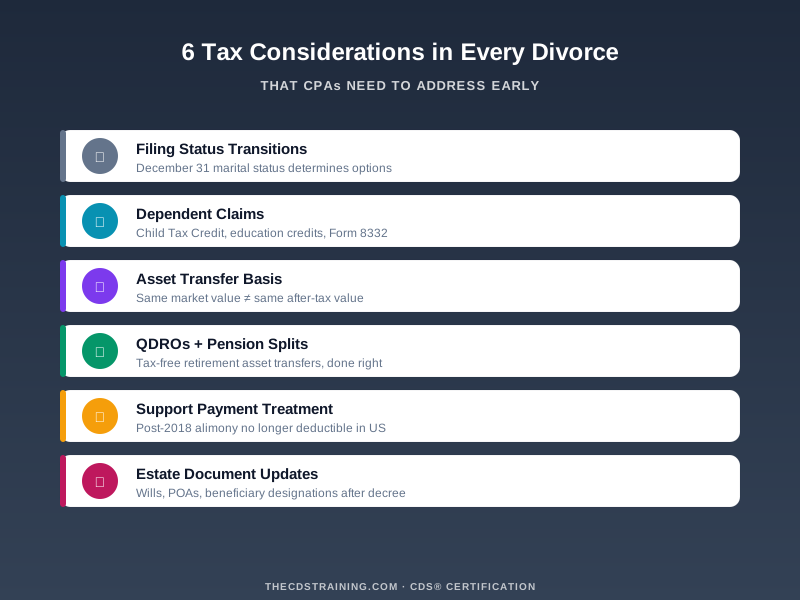
1. Filing Status Transitions
Your marital status on December 31 determines your filing options. Clients divorcing near year-end face material choices about whether to accelerate or delay finalization. CPAs coordinate with the client’s attorney on timing so the tax picture is factored into the decree schedule.
2. Dependent Claims
Which spouse claims children affects the Child Tax Credit, dependent care benefits, education credits, and other provisions. Most decrees address this explicitly, but CPAs often need to verify the language and ensure the IRS Form 8332 is properly filed when needed.
3. Asset Transfer Tax Basis
Transfers of property between spouses incident to divorce are generally tax-free, but the receiving spouse takes over the transferor’s basis. That means a “50/50” split by current market value can be dramatically unequal in after-tax terms if one asset has appreciated substantially while the other has not.
4. Retirement Account Splits
QDROs (Qualified Domestic Relations Orders in the US) or pension division orders (Canada) govern the tax-free split of retirement assets. Getting the QDRO right — and coordinating it with the plan administrator — is often the most complex mechanical task in a divorce.
5. Support Payment Tax Treatment
Since the Tax Cuts and Jobs Act (2019 US), alimony is no longer tax-deductible to the payer or taxable to the recipient for post-2018 decrees. This changed the economics of settlement negotiations. Canadian rules differ. CPAs help clients model the true after-tax cost of proposed support arrangements.
6. Estate Documents and Beneficiary Updates
Divorce triggers a full estate-document review — wills, powers of attorney, beneficiary designations on retirement accounts and life insurance. CPAs often catch these when clients don’t.
Where CPAs Need Cross-Disciplinary Context
Every tax decision in a divorce interacts with the legal settlement, the financial plan, and often the real-estate transaction. CPAs advising divorce clients well need to understand:
The Legal Framework
How the settlement is structured, what the decree specifies, and what’s subject to modification.
The Financial Plan
How the tax decisions fit into the client’s post-divorce cash flow and retirement projection.
Real Estate Decisions
Whether to sell the marital home, when, and how proceeds get allocated.
Emotional Timing
When clients can actually absorb complex tax advice — and when they need to defer decisions.
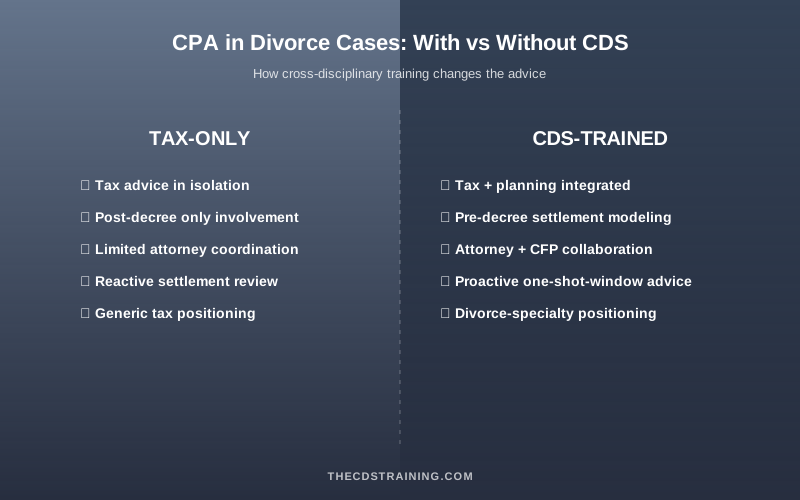
Why CDS Training Fits CPAs
The CDS curriculum gives CPAs the shared vocabulary of the divorce professional team. That translates directly into better client outcomes — because tax advice landed at the wrong moment in a divorce process often doesn’t stick, even when it’s technically correct.
CDS vs CDFA for CPAs
CPAs pursuing divorce specialization often ask whether to pursue CDFA (financial depth) or CDS (cross-disciplinary breadth). Many hold both. See our full comparison: CDS vs CDFA.
Related reading: building a divorce practice as a financial planner and divorce cases attorneys handle.
Ready to Specialize in Divorce Tax?
See the CDS curriculum for CPAs building a divorce-focused practice.