Short answer: CDS training is worth it if you already serve — or want to serve — clients going through divorce, and you’re looking to stand out from generalists in your field. The Certified Divorce Specialist (CDS)® designation is the only cross-disciplinary divorce credential built specifically for professionals in the legal, financial, mental health, and real estate industries. That specificity is exactly what makes it valuable: a divorcing client rarely needs a specialist in just one discipline. Below, we break down who CDS training actually pays off for, what you learn, and how to decide whether the credential fits your practice.

What Makes CDS Different from Other Divorce Credentials
Most divorce-related certifications focus on a single discipline. A CDFA trains financial planners. A CDC prepares life coaches. Real estate certifications like CDRE and RCS-D teach realtors how to handle marital property. Each is deep, but narrow.
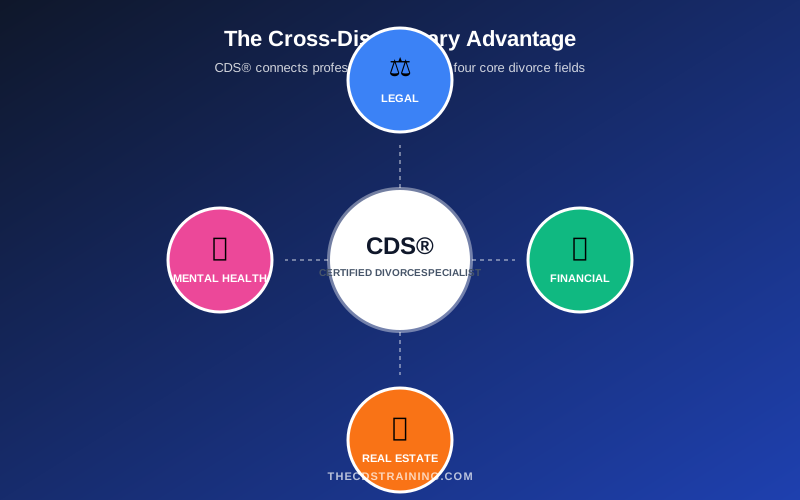
CDS was built by the National Association of Divorce Professionals (NADP) to fill a different need — to give professionals of any background a shared language, an understanding of the whole divorce process, and the tools to collaborate with the other disciplines involved in a client’s case.
Career Impact by Profession
The value of CDS looks slightly different depending on which industry you come from. Here’s how graduates in each field typically describe the outcome.
For Attorneys and Family-Law Practices
Family-law attorneys use CDS to position their practice as a full-service resource rather than just document-processing. Graduates report a shift in the kinds of clients they attract — higher-asset, more complex divorces where empathy and process knowledge matter as much as courtroom skill. See our CDS training track for attorneys for more.
For Financial Planners, CPAs, and Wealth Managers
CFPs and CPAs already know the numbers. CDS adds the emotional intelligence and process context needed to serve divorcing clients well — from asset-division mechanics through post-divorce cash-flow planning. It’s also a natural credential to pair with an existing CDFA designation. Learn more on our CDS for financial planners page.
For Therapists and Mental Health Professionals
Divorce is one of life’s most stressful events. Therapists trained through CDS learn to recognize where their scope ends and other disciplines take over — a critical skill for client safety and referral partnerships. Our CDS for mental health professionals page has more.
For Real Estate Professionals
Divorce real estate is a specialized niche with unique legal, tax, and emotional dimensions. CDS-certified realtors position themselves as the trusted local expert other divorce professionals refer to. Details on our CDS for realtors page.
For Mortgage Loan Officers and Related Financial Roles
Mortgage professionals see divorcing clients constantly — buyouts, refinances, new-purchase financing after a split. CDS training helps loan officers navigate the unique credit, income-verification, and timing challenges these files present.
For Mediators, Coaches, and Peacemakers
Divorce mediators and coaches use CDS to deepen their understanding of the legal and financial issues clients face outside the mediation room. See our CDS for mediators and peacemakers track.
What You Actually Learn in the CDS Curriculum
The CDS curriculum is delivered over 16 hours, split between two core modules: communication skills and multi-disciplinary expertise. It’s structured to work whether you complete it in-person over two intensive days, in a hybrid schedule, or fully on-demand.
Client Communication
How to have difficult conversations with clients in emotional distress — active listening, boundary-setting, and de-escalation.
Legal Framework
The high-level legal process across jurisdictions, and where professionals of each discipline fit into it.
Financial Realities
Asset division, tax consequences, cash-flow modeling, and support-payment structures.
Real Estate & Property
The marital home, investment properties, and the timing decisions that impact both spouses.
Emotional Support
Recognizing stress responses, referring appropriately, and preserving your own energy.
Referral Networks
How to build and maintain a collaborative team across the four core disciplines.
What Graduates Say About the Outcome
The most consistent theme in graduate feedback isn’t a dollar-figure lift — it’s the shift in the kind of clients that start showing up. Graduates report:
- Referrals from other CDS graduates. The alumni network functions as a private referral engine, particularly across disciplines.
- More confidence in complex files. Divorce work is emotionally taxing; graduates say the curriculum gave them a framework to handle it without burning out.
- A clearer market position. “Family-law attorney” becomes “certified divorce specialist attorney” — a more specific promise, easier to market.
- Better collaboration with other professionals. When you understand what a CFP, therapist, and realtor actually do in a divorce, you make better referrals and receive better ones back.
You can browse public graduate testimonials or the full CDS directory to see the range of professionals who’ve completed the program.
Signs CDS Is the Right Fit for Your Practice
- You already work with divorcing clients occasionally and want to attract more of that work
- Your practice is in one of the four core disciplines (legal, financial, mental health, real estate)
- You value a cross-disciplinary perspective and referral relationships
- You want a professional credential recognized by other divorce specialists
- You’re comfortable with either self-paced learning or a short intensive format
- You want a deep, discipline-specific credential (a CDFA, LMFT, or JD may serve you better)
- Your practice has no realistic path to divorcing clients
- You’re looking for a licence or legal authority to practice — CDS is a designation, not a licence
A Quick Framework to Decide
If all four answers are yes, the next step is to review the CDS program details for your region — including format options and upcoming cohort dates — and reach out with any questions specific to your practice.
Ready to Explore CDS Training?
Get complete program details, format options, and start dates for your region — US and Canada.